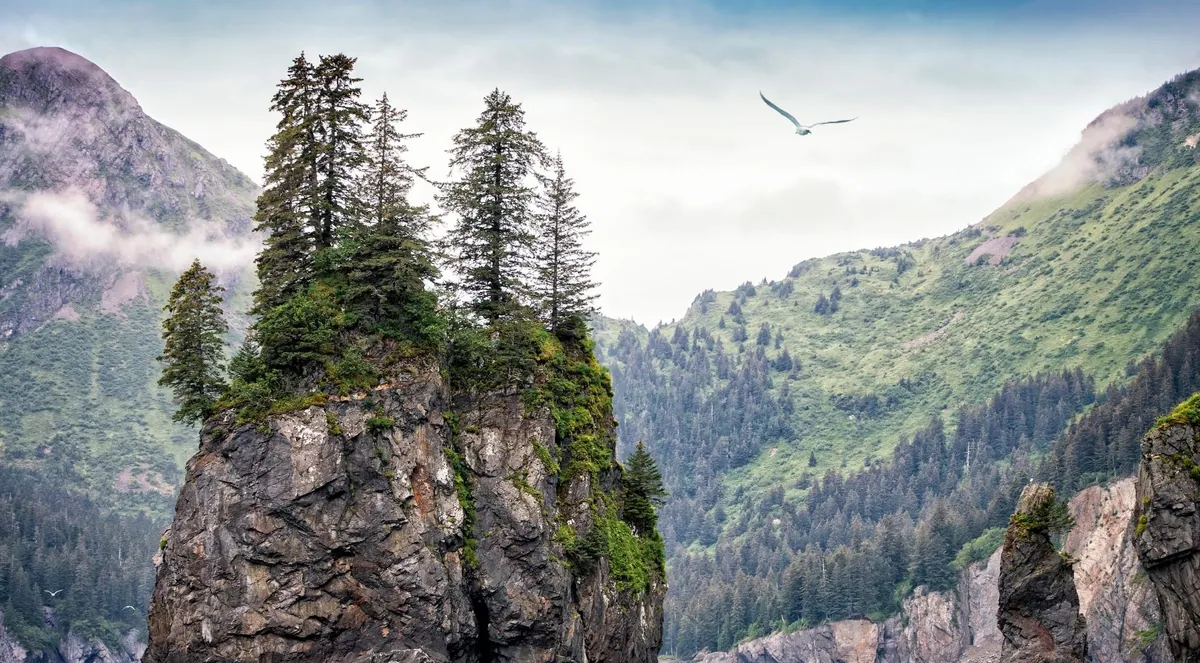
On a summer full-day cruise into Kenai Fjords you will almost certainly see Steller sea lions, harbor seals, sea otters, bald eagles, and both tufted and horned puffins. Humpback whales and Dall's porpoise are good odds. Orcas and coastal bears are lucky bonuses, so don't plan around them.
The richest stretch is the Chiswell Islands and Cape Resurrection, part of the Alaska Maritime National Wildlife Refuge, with hundreds of thousands of nesting seabirds and the area's only Steller sea lion rookery. If wildlife is your reason for going, book a full-day cruise that reaches them, such as the Major Marine 7.5-hour Kenai Fjords cruise (4.86/5 from 491 reviews on GetYourGuide), over a short Resurrection Bay glacier cruise.
Kenai Fjords is a marine wildlife park first. The National Park Service has documented 191 bird species here (a park checklist reaches 226 when adjacent and unconfirmed records are counted) and close to 30 land mammal species, but the dependable, high-density viewing happens on the water: sea lions, seals, otters and the seabird cliffs. Wildlife concentrates because glacial meltwater carries fine mineral “rock flour” into the fjords and coastal upwelling lifts nutrients to the surface, and together they feed the plankton blooms that support everything from forage fish to whales.
This is a recovering ecosystem. The 2014–2016 marine heatwave known as “the Blob” killed an estimated 4 million common murres, more than half of Alaska's population, with no sign of recovery through 2025, and forage-fish declines still run through the food web. The wildlife is abundant, but it is not the wildlife of 15 years ago.
What you'll see on a summer cruise
Sighting odds are qualitative: they describe typical summer conditions, and weather, sea state and the month all change what a given trip finds.
Reliable on a full-day cruise
Expect these
- Steller sea lions and harbor seals
- Sea otters and bald eagles
- Tufted and horned puffins, common murres and black-legged kittiwakes
- Mountain goats on the cliffs and Dall's porpoise
Good odds, not guaranteed
Likely on most days
- Humpback whales
- More seabird variety: pigeon guillemots, auklets and cormorants
Lucky bonuses
Enjoy them if they appear
- Orcas
- Coastal black or brown bears
- Peregrine falcon and harbor porpoise
Rare or essentially never
Don't plan around them
- Wolves, wolverine, lynx and coyote
- Moose from the boat
- Kittlitz's and marbled murrelets (present, but hard to identify)
- Gray whales outside the spring window
Wildlife cruise or glacier cruise?
In Kenai Fjords the difference is mostly the length of the route, not a different kind of boat. A full-day “glacier and wildlife” cruise that reaches the Chiswells, Aialik Bay or the Northwestern Fjord gives you both the tidewater glaciers and the best wildlife. The longest routes are Kenai Fjords Tours' Northwestern Fjord tour (4.87/5 from 43 reviews) and Major Marine's 7.5-hour cruise. A short Resurrection Bay cruise, such as the Kenai Fjords Tours Resurrection Bay half-day (4.70/5 from 99 reviews), is cheaper and gentler but sees fewer species. If wildlife variety matters most, book the longest outer-coast route you can tolerate, because the open water past the bay can be rough.
For a mid-length option, the Major Marine 6-hour national park cruise with lunch (4.85/5 from 948 reviews) and the Kenai Fjords Tours 6-hour glacier and wildlife cruise (4.81/5 from 202 reviews) both reach a tidewater glacier. Check the day's route if the Chiswell rookery is a must. Our boat tours guide compares every route.
Other experiences you might enjoy
Wildlife trips around Seward and Kenai Fjords National Park include glacier and wildlife cruises past the Chiswell Islands into Aialik Bay and the Northwestern Fjord, sea kayaking with sea otters in Resurrection Bay, guided Exit Glacier hikes, and Turnagain Arm day tours from Anchorage for Dall sheep and beluga whales.
The Kenai Fjords wildlife calendar
What you can see, and the months you're most likely to see it. Marine wildlife is viewed from boat tours; a few species are seen on land near Exit Glacier.
| Wildlife | When present | Best months | Where |
|---|---|---|---|
| Humpback whales | April–October | Mid-May–mid-Aug | Open water and the fjords |
| Orcas (killer whales) | Year-round | Mid-May–June | Resurrection Bay & the fjords |
| Gray whales | March–May (spring migration only) | Mid-April–May | Mouth of Resurrection Bay |
| Tufted & horned puffins | Arrive ~mid-May, into August | June–July | Chiswell / Beehive Islands |
| Steller sea lions | Haul-outs early spring–late July; pupping peaks in June | May–July | Chiswell Islands rookery, Cape Resurrection, Rugged Island |
| Sea otters | Year-round (resident) | All summer | Resurrection Bay & coves |
| Harbor seals | Pupping late May–June; molting July–September | June–Aug | On icebergs near Aialik and Northwestern glaciers |
| Black bears | Summer | June–Aug | Exit Glacier / Harding Icefield Trail |
| Mountain goats | Summer | June–Aug | Coastal cliffs, seen from boats |
Whale and puffin windows shift a few weeks year to year; the Chiswell Islands, the main seabird and sea-lion site, lie just outside the park in the Alaska Maritime National Wildlife Refuge. Precise viewing months for sea otters and black bears beyond “summer” or “resident” are not closely documented.
Month by month, March to October
- March–April: gray whales migrate past the outer coast (roughly March to May). Steller sea lions and harbor seals are present year-round, but few tours are running and the seabird colonies are not yet active.
- May: the season opens and seabirds begin gathering. Tufted puffins reach the rookeries in mid-May and horned puffins about a week later, harbor seal pupping begins late in the month, humpbacks are returning, and mountain goats move down to greener slopes.
- June: peak seabird nesting, Steller sea lion pupping at its height, harbor seals pupping on the glacier ice, puffins and murres on the cliffs and very long days. Excellent all-round viewing.
- July: the busiest month for visitors and generally the best all-round month for wildlife, with seabird chicks, feeding humpbacks, salmon runs building and harbor seals starting to molt. Belugas appear in Turnagain Arm from mid-July.
- August: seabirds are still present, although the colonies start to disperse late in the month. Whale activity is strong, salmon peak in the streams (the best time for bears and eagles at salmon), and belugas are in Turnagain Arm.
- September: puffins and many seabirds leave for open water; whales are still around, coho salmon are running, fewer tours operate and the weather becomes more variable.
- October: the season winds down. Most seabirds are gone, the marine mammals remain, and tour availability is limited.
If you can choose, June or July gives the best all-round viewing: seabirds nesting, sea lions and seals pupping, puffins on the cliffs and whales feeding. May suits early puffins and the tail of the gray whale migration; from September the seabirds thin out. Our best time to visit guide covers weather, daylight and crowds.
Seabirds: the under-rated headline act
Kenai Fjords is one of the best places in Southcentral Alaska to see nesting seabirds at close range, and the seabird story here is richer than most visitors expect.
Tufted and horned puffins
Two puffin species nest in the park. The tufted puffin (Fratercula cirrhata) is the larger and showier, with a white face, a large orange-red bill and two curling yellow head tufts in breeding plumage. The horned puffin (Fratercula corniculata) has pure white underparts and cheeks, a yellow-and-red bill and a small fleshy black “horn” above each eye. Both stand about 15 inches tall, but the tufted is heavier, about 1.7 lb against 1.4 lb.
A useful way to tell them apart: tufted puffins dig burrows in grassy slopes and on vegetated island tops, while horned puffins nest in rock crevices and on cliff ledges. You will more often see horned puffins perched on bare rock and tufted puffins circling over the grassy tops of the islands. Tufted puffins arrive at the rookery islands about mid-May and horned puffins about a week later. Both mate for life and lay a single egg in June or July, which both parents incubate for 42–47 days.
The best places to look are the Chiswell Islands and the “Beehive” islands, named for the beehive-like swirl of nesting puffins, plus the cliffs around Cape Aialik and the approaches to Resurrection Bay. In season, puffins are close to a sure thing on a full-day cruise.
Murres, kittiwakes and the other cliff-nesters
Common murres are the dominant cliff-nesting seabird. Thick-billed murres are far scarcer: in the Gulf of Alaska fewer than 1% of murres are thick-billed. Black-legged kittiwakes nest in dense, noisy colonies on the cliff faces and are often seen wheeling over bait balls. Pigeon guillemots (black, with white wing patches and bright red feet), rhinoceros auklets and parakeet auklets are all here, as are pelagic and red-faced cormorants. Glaucous-winged gulls are everywhere.
The murrelets, including the “glacier murrelet”
Marbled murrelets are seen in the fjords. The rarer Kittlitz's murrelet (Brachyramphus brevirostris) is one of the park's most compelling conservation stories. More than 95% of the world's population breeds in Alaska, and around Kenai Fjords it is found almost only near tidewater glaciers, feeding in the silty meltwater at the heads of fjords such as upper Aialik Bay and Northwestern Lagoon, hence the nickname. It does not nest in colonies: each pair nests alone on bare rock and scree in the mountains and relies on camouflage.
Surveys have recorded steep declines. A USGS study estimated roughly 509 birds along the south Kenai Peninsula coast in 2002, an 83% decline since 1976. Because the bird depends on glacial habitat, glacier retreat is a direct threat, and a 2025 Alaska SeaLife Center and University of Alaska Fairbanks study is investigating shifts in where it lives. Most visitors will not knowingly see or identify one. It is a birder's target, best looked for near the glacier faces or on the return leg from the Chiswells.
Raptors
Bald eagles are common and reliably seen perched along the coast and near salmon streams. Peregrine falcons nest on the coastal cliffs and are an occasional, prized sighting.
The Chiswell Islands and the Alaska Maritime refuge
The Chiswell Islands sit at the mouth of Aialik Bay, about 35 miles south of Seward, and are managed as part of the Alaska Maritime National Wildlife Refuge. According to the U.S. Fish and Wildlife Service, the refuge protects breeding habitat for an estimated 40 million seabirds of more than 30 species, roughly 80% of Alaska's nesting seabirds and more than half of all nesting seabirds in the United States. Other sources describe it as 15 to 30 million birds of 55 species, so treat the exact figure as approximate.
The Chiswells themselves hold hundreds of thousands of nesting seabirds (horned and tufted puffins, black-legged kittiwakes, murres, auklets and cormorants) and the only known Steller sea lion rookery in the immediate area. The islands rise almost vertically from the sea with virtually no beaches, so you see them from the boat; landing is not an option.
The Alaska SeaLife Center in Seward has monitored the Chiswell Island sea lion rookery with remote video cameras since 1998 and streams a live rookery webcam, which is good for trip planning and a decent substitute on a foggy day.
The murre die-off: the science every visitor should know
The most important recent finding for anyone interested in Kenai Fjords wildlife is Renner et al., “Catastrophic and persistent loss of common murres after a marine heatwave,” published in Science in December 2024. The study estimated that 4 million common murres, more than half of Alaska's population, died during the 2014–2016 “Blob” marine heatwave, with no evidence of recovery, which suggests the heatwave may have shifted the ecosystem. It is described as the largest die-off of a single wildlife species ever documented. Before the heatwave, Alaska held about 8 million common murres, roughly a quarter of the world's population.
The U.S. Fish and Wildlife Service, in “Four million murres missing,” notes that “by the end of 2016, biologists and volunteers had counted more than 62,000 common murre carcasses on Alaska's beaches,” three-quarters of them in the Gulf of Alaska and only a fraction of the true losses at sea. Lead author Heather Renner, supervisory biologist at the Alaska Maritime National Wildlife Refuge, put the scale this way: “the murre die-off was approximately fifteen times larger than the number of seabirds killed during the Exxon Valdez oil spill.” The story is still developing and the figures may be revised; these are the current best estimates.
Sea lions, seals, otters and whales
Steller sea lions
Western population — endangered
- The sea lions here belong to the western distinct population segment, listed as endangered under the Endangered Species Act in 1997 after a decline of roughly 77–81% from the 1970s to the early 2000s.
- NOAA's 2023 Alaska stock assessment: “the updated best model estimated count, derived from aerial photographic and land-based surveys in 2021 and 2022, is 49,837 sea lions,” down from a previous estimate of 52,932. The population has grown slowly overall since 2003, but is still declining in the western Aleutians.
- The Chiswell rookery mirrors the wider decline: about 90% fewer animals, from 1,106 adults in 1976 to roughly 90 adults and 50–80 pups in the 2000s.
- Males weigh 1,500–2,200 lb, females 600–800 lb. Pupping peaks in June. Reliable haul-outs at Chiswell Island, Cape Resurrection and around Rugged Island make them close to guaranteed on a full-day cruise.
Harbor seals on the ice
A signature Kenai Fjords sight
- Harbor seals are abundant and haul out on icebergs calved from Aialik and Northwestern glaciers to give birth, nurse and molt.
- Pupping runs from roughly late May into June; molting from July into September.
- Research along 250 km of Kenai Fjords coastline (2004–2013) documented these ice-associated groups, and numbers in Aialik Bay have declined over recent decades.
- Because boats disturb seals in glacial fjords and glacier retreat is shrinking their ice, NOAA's Alaska Harbor Seal Approach Guidelines ask all vessels, from kayaks to cruise ships, to stay 500 yards from seals on ice where safely possible, stricter than the general 100-yard guidance.
Sea otters
Keystone species, not ESA-listed here
- Usually seen floating on their backs in kelp, often in groups called rafts. Sea otters have the densest fur of any mammal.
- By eating sea urchins they keep kelp forests from being grazed bare, which sustains a far richer nearshore ecosystem. Hunted almost to extinction in the 18th- and 19th-century fur trade, they have recovered across much of their range.
- The ESA-listed threatened population is the Southwest Alaska stock (Aleutians, Alaska Peninsula, Kodiak), listed in 2005. The otters in Kenai Fjords belong to the Southcentral stock, which is not listed; its latest estimate is about 21,617 animals (2014–2019 surveys), stable and possibly increasing.
- Look in the kelp beds of Resurrection Bay, Aialik Bay and sheltered coves throughout the fjords.
Whales
Humpbacks, orcas & gray whales
- Humpbacks are the summer staple and sometimes bubble-net feed cooperatively.
- Resident, fish-eating orca pods chase salmon and are seen year-round, but orcas are never guaranteed.
- Gray whales pass only on the spring migration, roughly March to May.
- Species profiles, sighting odds by cruise and the AT1 orca story are in our whale watching guide.
Land mammals: goats, bears, marmots and the ones you won't see
The park lists close to 30 land mammal species. Here is the realistic picture for a visitor:
- Mountain goats are the land mammal you are most likely to see from a boat: white dots on the steep green cliffs of Resurrection Bay and the fjords. The Kenai population is significant and well studied. Goats were GPS-collared in 2017–2018, and 20 more were collared inside the park in October 2022. A study covering 2010–2019 found that as summer temperatures rise, goats cut back on midday activity and move to snow patches and higher, cooler ground; a related study found that resting on snow lowered their breathing rate by as much as 15%. Heat stress is a real climate risk for an alpine animal with no shade.
- Black bears and brown (grizzly) bears both live here, and the Kenai Peninsula brown bear is an Alaska species of special concern. Bears are seen now and then from cruises along the shore and at salmon streams, and coastal black bears sometimes forage around Pedersen Lagoon and Aialik Bay, visible for example from the Kenai Fjords Glacier Lodge. Near Seward, bears are active around Exit Glacier. On a standard cruise a bear is a bonus, not an expectation.
- Moose live in the forested lowlands and wetlands and along the Seward Highway, but are not usually seen from the fjord cruises.
- Hoary marmots are commonly seen, and heard whistling, by hikers on the Harding Icefield Trail above Exit Glacier. Porcupine, snowshoe hare, red squirrel and ermine are other frequent sightings.
- Rarely or essentially never seen: wolf, coyote, lynx, wolverine, marten, river otter (occasionally), beaver, mink, flying squirrel and little brown bat. They are here but elusive; don't plan around them.
If you want a guide on the land side, the guided Exit Glacier nature hike (4.66/5 from 29 reviews) covers the trails where bears, goats and marmots are most often seen. Our Exit Glacier guide has the trail details and bear rules.
Fish and marine life
Salmon
All five Pacific salmon species occur on the Kenai Peninsula. General run timing on the Kenai River system, which shifts from year to year: king (Chinook) mid-May through July; sockeye (red) from early July, peaking late July into mid-August; pink mid-July through August; coho (silver) late July through October, peaking in September; and chum in summer. Around Seward, the Resurrection River and local streams see salmon returns that draw eagles and bears. Cruise passengers rarely see the salmon themselves, but the whole land food web depends on them.
Groundfish and forage fish
Halibut, rockfish and lingcod are the region's marine sportfish. The ecological linchpins are the small, energy-rich forage fish, Pacific herring, capelin and sand lance (plus krill), which feed the seabirds, whales, seals and sea lions. Their collapse during the 2014–2016 heatwave is the mechanism behind the murre die-off. Capelin crashed from record highs to record lows by 2016, and NOAA scientists found that during heatwaves the energy predators could get from capelin fell to less than 1% of pre-heatwave levels. Monitoring in 2024–2025 shows capelin recovering somewhat in seabird diets while sand lance remain low, a mixed and still-fragile picture.
Tide pools and kelp forests
At low tide the rocky shores reveal sea stars, mussels, barnacles, anemones, chitons and hermit crabs. Kelp forests, kept alive by the sea otters, shelter a rich community, and several jellyfish species, including large lion's mane jellyfish, drift at the surface in summer.
Where to see wildlife around Kenai Fjords
Five ways in, from a full-day cruise to a roadside pullout. The cruise is the core of it.
From a boat cruise
The core experience
- The Chiswell Islands and Cape Resurrection: seabird colonies, the sea lion rookery, sea otters and puffins.
- Aialik Bay: harbor seals on the ice at Aialik Glacier, sea otters, possible coastal bears at Pedersen Lagoon.
- Northwestern Fjord: harbor seals, Kittlitz's murrelet habitat and dramatic tidewater glaciers. Bear Glacier is on the way out.
- Shorter Resurrection Bay cruises see otters, seals, eagles, mountain goats and often Dall's porpoise, but miss the big seabird colonies and the outer-coast rookery. The Major Marine 4-hour wildlife cruise (4.65/5 from 328 reviews) is the gentler choice.
From Exit Glacier and the Harding Icefield Trail
The road-accessible park
- Hoary marmots on the Harding Icefield Trail.
- Black bears active around Exit Glacier: heed closures and food-storage rules.
- Occasional mountain goats on the surrounding slopes.
From shore in Seward
A casual walk, not a cruise substitute
- Sea otters, harbor seals, sea lions and eagles are often visible from the Seward waterfront, Lowell Point and the trail to Caines Head.
From a kayak
Close, quiet and regulated
- Sea otters, harbor seals and seabirds at close but regulated range in Resurrection Bay and, on guided drop-off trips, in Aialik Bay.
- Kayakers must keep the same marine-mammal distances as motor vessels, including the 500-yard harbor-seal guidance in glacial fjords.
- The Tonsina Point sea kayaking trip (4.96/5, but from only 15 reviews) is a Resurrection Bay half-day; see our kayaking guide for the glacier paddles.
Along the Seward Highway
The Turnagain Arm stretch south of Anchorage is a wildlife corridor in its own right, and most visitors drive it on the way to Seward. Look for Dall sheep on the cliffs at Windy Corner (around Mile 106), beluga whales in Turnagain Arm from mid-July through August from Beluga Point (Mile 110) and Bird Point (Mile 96), and moose in the forested sections. The Cook Inlet beluga is endangered: it was listed in 2008 after a decline of about 75% from roughly 1,300 whales in 1979, and the 2022 median best estimate was 331 (range 290–386), up modestly from 279 in 2018. Sightings from shore are possible but not guaranteed. Windy Corner is notorious for near-collisions, so pull fully off the road. Without a car, the Turnagain Arm full-day tour from Anchorage (4.62/5 from 78 reviews) stops along the same shore. Route details are in our getting there guide.
The Alaska SeaLife Center
The Alaska SeaLife Center on the Seward waterfront opened in 1998, built largely with Exxon Valdez oil-spill settlement funds. It is Alaska's only permanent marine mammal rescue and rehabilitation facility and the only institution authorized to rehabilitate stranded marine mammals in the state, working under NOAA and U.S. Fish and Wildlife Service permits. It also runs the Chiswell Island Steller sea lion research program and the live rookery webcam.
For visitors it works as a public aquarium: a two-story seabird aviary where puffins and other seabirds “fly” underwater and overhead, underwater viewing of Steller sea lions and harbor seals, salmon and octopus exhibits, and touch tanks with sea stars and urchins. It is an excellent complement to a cruise, and a good substitute on a rain or fog day or for families with young children, because the close-up viewing and interpretation are guaranteed. Most visitors spend 1.5–3 hours, and the center is fully accessible. Admission is booked directly with the center; see our Seward guide for the details.
Viewing rules and distances
- Humpback whales: federal law, in force since July 2001, requires vessels to stay 100 yards away and not to put a vessel in a whale's path, at a slow, safe speed near whales.
- Other marine mammals: stay at least 100 yards from whales. NOAA recommends at least 50 yards from seals, sea lions, dolphins and porpoises, and limiting observation to 30 minutes.
- Harbor seals in glacial fjords: NOAA's Alaska guidelines recommend 500 yards from seals on ice where it is safe to do so, because the Aialik and Northwestern ice is essential, disturbance-sensitive habitat.
- Steller sea lions: watch from at least 100 yards, for no more than 30 minutes, don't approach rafting animals, and stay out of the no-entry buffer zones around designated rookeries. West of 144°W it is illegal to discharge a firearm at or within 100 yards of a Steller sea lion. They stampede easily and are sensitive to aircraft.
- Alaska Maritime refuge seabird islands: the Chiswells and similar islands are protected sanctuaries, viewed from boats; they are steep, beachless and managed to prevent disturbance, so there is no public landing.
- Bears: follow the park's bear-safety and food-storage guidance, and never approach or feed a bear. Our safety guide has the details.
- Drones: prohibited in every National Park Service unit, Kenai Fjords included, since 2014 (Policy Memorandum 14-05). Launching, landing or flying one in the park is a federal offense.
- Whale SENSE: a voluntary NOAA and industry program, running in Alaska's Juneau-area whale-watching community since 2015, that recognizes operators committed to responsible viewing. Choosing a responsible operator matters.
This is the same living, working coast that has sustained the Sugpiaq (Alutiiq) people for thousands of years, whose subsistence harvest still centers on these waters. Keep your distance, as tour operators and the park require.
Spotting and photography tips
Bring binoculars
- The single most useful thing you can pack. A compact or mid-size 8×42 or 10×42 pair transforms the trip, because much of the wildlife is seen at a distance.
Lenses
- A 100–400mm telephoto (or a 70–300mm) is the practical range from a boat. Longer primes are hard to hold steady on a moving deck; use a faster shutter speed to beat the boat's motion.
Where to stand
- Spend time on the open deck, not behind glass. Scan the waterline for otters and porpoises and the cliffs for goats and seabirds, and follow the crew's callouts: naturalists spot far more than passengers do.
Set your expectations
- Most marine mammals and seabirds are seen at tens of yards or more, not at arm's length. This is wild viewing at regulated distances, not a zoo.
Conservation stories, 2024–2026
- The murre die-off: about 4 million common murres lost, more than half of Alaska's population, with no recovery through 2025 (Science, December 2024). This is the defining recent story, and it could change with new survey years.
- Forage fish and the heatwave: capelin, herring and sand lance collapsed in 2014–2016. Capelin is partly back in seabird diets; sand lance is still low (2024–2025). The Gulf of Alaska food web remains disrupted.
- Steller sea lions: the western population is still endangered, growing slowly overall since 2003 but declining in some regions.
- Sea otters: the Southcentral (Kenai Fjords) stock is stable or increasing at about 21,600; the Southwest stock is still threatened.
- Kittlitz's murrelet: dependent on glaciers, with steep historical declines; research continues, and glacier retreat is the central threat.
- AT1 (Chugach) transient orcas: a small, genetically distinct mammal-eating group ranging from Prince William Sound to Kenai Fjords. The 1989 Exxon Valdez spill devastated it, and 15 of the original 22 members were ultimately lost. According to NOAA Fisheries there have been no observed births since 1984, the group has declined to 7 individuals, it was designated depleted under the Marine Mammal Protection Act in 2004, and it is not expected to recover. Transient orcas you do see are far more likely to come from the healthy Gulf of Alaska transient population.
- Long-term monitoring: the NPS Southwest Alaska Network Inventory & Monitoring program continues to track sea otters, seabirds and nearshore ecosystems across the network, Kenai Fjords included.
Population figures and listing statuses change with each new survey; the numbers on this page are the latest published estimates we could find.
How to plan a wildlife trip, and when to go elsewhere
- Book a full-day outer-coast cruise from Seward, the “glacier and wildlife” kind that reaches the Chiswell Islands, Cape Resurrection and Aialik Bay or the Northwestern Fjord, such as the Major Marine 7.5-hour cruise or the Kenai Fjords Tours Northwestern Fjord tour. It gives you the most species and is the only reliable way to see the seabird colonies and the sea lion rookery. If you are prone to seasickness or traveling with very young children, choose a shorter Resurrection Bay cruise and pair it with the SeaLife Center.
- Go in June or July for the best all-round viewing.
- Bring 8×42 or 10×42 binoculars and a 100–400mm lens, and spend time on the open deck following the crew's callouts. After the length of the route, nothing else does as much for what you see.
- Add the Alaska SeaLife Center as a weather backup and for guaranteed close-up viewing, especially on a fog or rain day or with kids.
- View ethically: choose a responsible operator, respect the 100-yard whale and 500-yard glacial-fjord seal distances, and leave the drone at home.
If one animal is your priority
- Brown bears: go to Katmai (Brooks Falls) or the Katmai and Lake Clark coast on a fly-in trip from Homer or Soldotna. Kenai Fjords is not a bear-viewing destination, and you should not expect bears from the boat.
- Shorebirds and a huge species list: Homer and Kachemak Bay, including the Kachemak Bay Shorebird Festival.
- Land mammals (grizzlies, caribou, Dall sheep, moose in numbers): Denali National Park. Our Kenai Fjords vs Denali comparison helps you choose or combine them.
- Guaranteed close-up marine wildlife whatever the weather: the Alaska SeaLife Center in Seward.
Are sightings guaranteed? No, but operators report high whale-sighting rates — Major Marine states roughly 80–95% depending on the cruise. Treat that as an operator figure, not a guarantee. Compare cruises on our boat tours guide to match a trip to the wildlife you most want to see, and read the whale watching guide for the odds by species.
Wildlife questions
On a summer full-day cruise from Seward you will almost certainly see Steller sea lions, harbor seals, sea otters, bald eagles and both tufted and horned puffins, along with common murres, black-legged kittiwakes, mountain goats on the cliffs and Dall's porpoise. Humpback whales are likely but not guaranteed. Orcas, coastal bears and peregrine falcons are lucky bonuses. On land near Exit Glacier you may see black bears, mountain goats, moose and hoary marmots.
Humpback whales are seen from April to October, best mid-May to mid-August. Orcas are present year-round, best mid-May through June. Gray whales pass only during the spring migration, roughly March to May, best mid-April to May at the mouth of Resurrection Bay.
Tufted puffins arrive at the rookery islands around mid-May and horned puffins about a week later. Both nest from May to August, with the best viewing in June and July around the Chiswell and Beehive Islands. By September most have left for open water. These windows shift a few weeks from year to year.
Yes, both black and brown bears. Black bears are seen almost daily along the Harding Icefield Trail near Exit Glacier in summer, and coastal black bears sometimes forage around Pedersen Lagoon and Aialik Bay. From a standard cruise, though, a bear is a bonus. If brown bears are your priority, Katmai is the place to go.
No sightings are guaranteed, but boat operators report high whale-sighting rates. Major Marine states roughly 80 to 95 percent depending on the cruise. Treat that as an operator figure rather than a guarantee, since weather, sea state and animal movements vary.
The longest outer-coast cruise you can comfortably manage. The Chiswell Islands, with hundreds of thousands of nesting seabirds and the area's only Steller sea lion rookery, are reached on the full-day routes, such as the Northwestern Fjord tours and some 7.5-hour cruises. Half-day Resurrection Bay cruises still see otters, seals, eagles, mountain goats and often Dall's porpoise, but they miss the big seabird colonies and the rookery.
No. The Chiswells rise almost vertically from the sea with virtually no beaches, and they are managed as part of the Alaska Maritime National Wildlife Refuge to protect nesting seabirds and sea lions. You view them from the boat.
Federal law requires every vessel, kayaks included, to stay 100 yards from humpback whales. NOAA recommends at least 50 yards from seals, sea lions and porpoises, with viewing limited to 30 minutes, and asks all vessels in glacial fjords to stay 500 yards from harbor seals on the ice where it is safe to do so. Drones are prohibited in all national parks, Kenai Fjords included.
Yes, as a complement to a cruise and as a good substitute on a rain or fog day or with young children. It is Alaska's only permanent marine mammal rescue and rehabilitation center and a public aquarium, with a two-story seabird aviary, underwater viewing of Steller sea lions and harbor seals, and touch tanks. Most visitors spend 1.5 to 3 hours, and it is fully accessible.
Related guides
Ready to see it for yourself?
The wildlife is mostly on the water, so the tour you pick shapes what you'll see. Compare cruises and choose one that reaches the whales, puffins and sea lions.