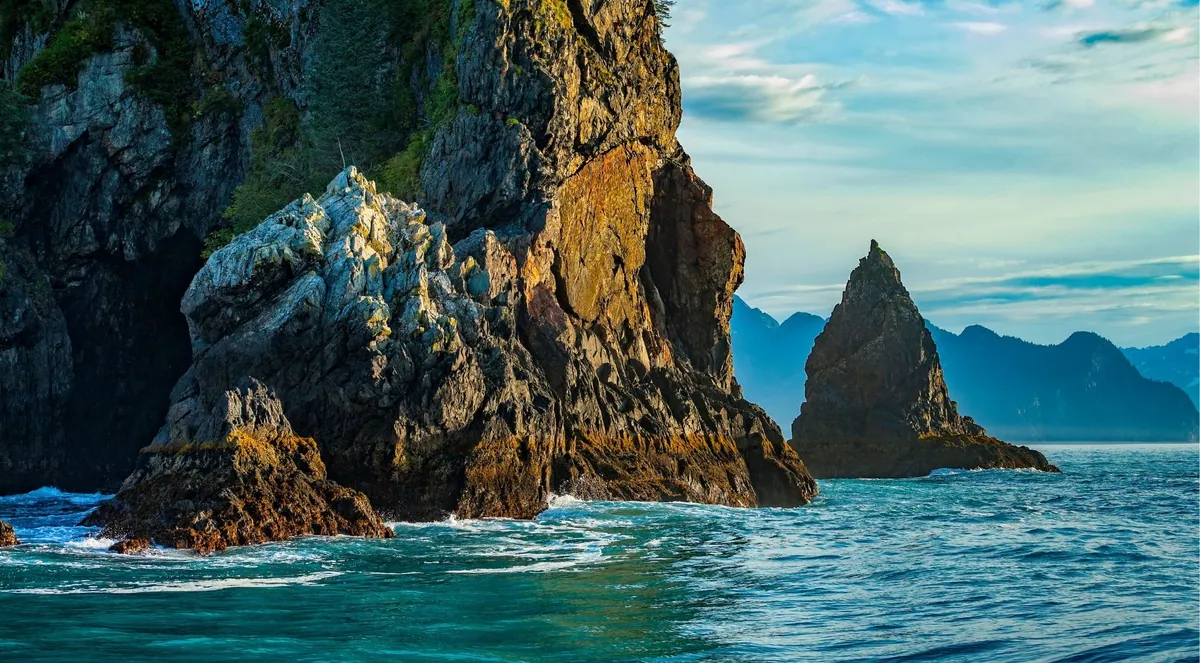
The outer Kenai coast is the homeland of the Sugpiaq — also known as the Alutiiq — a maritime people who have lived here for thousands of years. The land was protected in stages, as a national monument in 1978 and a national park in 1980, and the 1989 Exxon Valdez oil spill left a lasting mark on its shoreline and its communities. Understanding the park means starting with the people whose home it has always been.
It's easy to read Kenai Fjords purely as ice and wildlife. But the fjords are also a cultural landscape — a coast that people have navigated, harvested and lived on for a very long time, and where Alaska Native land and communities remain today.
The Sugpiaq (Alutiiq) of the outer coast
The outer fjord coast is the homeland of the Sugpiaq, also known as the Alutiiq — a maritime people of south-central Alaska. The Alutiiq Museum documents Alutiiq presence across the wider region for more than 7,500 years; within Kenai Fjords itself, the National Park Service records Sugpiaq use of this coast going back at least 1,000 years. Life was built around the sea: fish and marine mammals, read through tides, weather and ice. The Sugpiaq of this particular coast are more precisely the Chugach (Chugachmiut), and their dialect is Sugcestun.
What the names mean: “Sugpiaq” (plural Sugpiat) means “the real people,” from suk (person) plus -piaq (real). “Aleut” is a term Russian fur traders applied to the region's Native peoples, and “Alutiiq” is the Sugpiat pronunciation of that Russian word. Both “Sugpiaq” and “Alutiiq” are used by the people themselves today.
The qayaq and a maritime way of life
Central to that life was the qayaq — the skin-on-frame kayak. Built on driftwood frames covered with sea-mammal skins, qayat came in single-, double- and triple-hatch forms; the triple-hatch version later carried Russian traders and officials along this coast. Alongside the qayaq, larger open skin boats (angyaq) moved people and goods, and families wintered in semi-subterranean sod houses. Subsistence — the harvest of fish, sea mammals, birds and plants — remains at the center of community life in the region today.
A note on the name “Kenai”: “Kenai” comes from the Dena'ina, an Athabascan people associated with the western and northern Kenai Peninsula — a different people from the Sugpiaq of the outer fjord coast. It's easy to conflate the two, but the fjords themselves are Sugpiaq/Alutiiq homeland.
From ancestral land to national park
Modern protection came in stages. Under the Alaska Native Claims Settlement Act of 1971, the Port Graham Corporation selected about 44,000 acres of ancestral coastal land, receiving title in 1995 — Alaska Native land that still lies within the park boundary. President Carter proclaimed Kenai Fjords a national monument on December 1, 1978 under the Antiquities Act, and Congress established it as a national park on December 2, 1980 under the Alaska National Interest Lands Conservation Act (ANILCA). The Exit Glacier area was the first part developed for public access.
The Exxon Valdez oil spill
On March 24, 1989, the tanker Exxon Valdez ran aground in Prince William Sound. Oil eventually reached about 20 miles — roughly 5% — of Kenai Fjords' coastline, part of some 1,300 miles of Alaskan shoreline oiled as far southwest as Chignik.
The spill hit the nearby Sugpiaq villages of Nanwalek and Port Graham especially hard, disrupting the subsistence harvest at the center of daily life. Chugach elder Chief Walter Meganack described it as “the day the water died.” Decades of monitoring and restoration have followed, and the coast's recovery is still studied today.
Where to learn more
The best sources are the community's own institutions and the park's cultural programs.
Alutiiq Museum
Kodiak, Alaska
- The region's leading center for Alutiiq culture, language and collections
- Exhibits, a language program and online resources
- A primary source for this page
Alaska SeaLife Center
Seward
- Interprets the ecology of the coast the Sugpiaq have long lived on
- A short walk from downtown Seward
- A good rainy-day stop before or after a cruise
NPS ranger programs
Kenai Fjords National Park
- Ranger talks and cultural programs in summer
- Share Sugpiaq history on site
- Ask at the Seward or Exit Glacier visitor centers
History & culture questions
The Sugpiaq, also known as the Alutiiq, are a maritime Alaska Native people whose homeland includes the outer Kenai coast. The Alutiiq Museum documents presence across the wider region for more than 7,500 years; within Kenai Fjords, the NPS records use of the coast going back at least 1,000 years. They have long lived on fish and marine mammals. The outer-Kenai group is more precisely the Chugach (Chugachmiut).
“Sugpiaq” (plural Sugpiat) means “the real people,” from suk (person) plus -piaq (real). “Aleut” is a term Russian fur traders applied to the region's Native peoples, and “Alutiiq” is the Sugpiat pronunciation of that Russian word. Both terms are used by the people themselves today.
No. “Kenai” comes from the Dena'ina, an Athabascan people associated with the western and northern Kenai Peninsula — a different people from the Sugpiaq of the outer fjord coast. The two should not be conflated: the fjords are Sugpiaq/Alutiiq homeland.
President Carter proclaimed it a national monument on December 1, 1978 under the Antiquities Act, and Congress established it as a national park on December 2, 1980 under ANILCA. Under the 1971 Alaska Native Claims Settlement Act, the Port Graham Corporation selected about 44,000 acres of ancestral coastal land within the park, receiving title in 1995.
After the Exxon Valdez ran aground in 1989, oil eventually reached about 20 miles — roughly 5% — of the park's coastline, part of some 1,300 miles of Alaskan shoreline oiled as far as Chignik. It hit the nearby Sugpiaq villages of Nanwalek and Port Graham hard by disrupting the subsistence harvest; Chugach elder Chief Walter Meganack called it “the day the water died.” Decades of monitoring and restoration have followed.
Related guides
Kenai Fjords tours & experiences
Other experiences you might enjoy — glacier and wildlife cruises, sea kayaking and flightseeing from Seward and Aialik Bay.
Plan a visit to the Sugpiaq coast
See the fjords the way they've always been reached — from the water — and walk up to the ice at Exit Glacier.